Understanding the Gap Between Commercial and Residential HVAC Systems
When business owners in Alhambra think about HVAC maintenance, they often apply residential thinking to commercial equipment—and that's where costly mistakes begin. Commercial HVAC systems operate on an entirely different scale than what homeowners typically encounter. Where a residential home might have a single 3-ton split system, a commercial building https://spencerwrng366.lowescouponn.com/hvac-repair-safety-in-camelback-east-village-health-risks-and-professional-protection could require rooftop units ranging from 5 to 50+ tons, chiller plants serving multiple zones, or variable refrigerant flow (VRF) systems that demand specialized knowledge. Alhambra is located in Phoenix, AZ, a region where the extreme desert heat makes reliable commercial cooling non-negotiable. On Time HVAC Phoenix serves Alhambra residents and business owners with the expertise to handle both residential and commercial equipment, drawing on experience since our founding in 2014. The regulatory landscape differs dramatically too—commercial systems must comply with stricter International Mechanical Code (IMC) standards, require commercial licensing (Arizona ROC CR-39 certification), and often involve building automation systems (BAS) that residential technicians rarely encounter.
Equipment Complexity and Sizing Differences
Commercial HVAC equipment is engineered for continuous operation in ways residential systems simply aren't designed for. Residential units typically cycle on and off throughout the day, while commercial systems often run continuously during business hours and may operate 24/7 in settings like data centers or hospitals. This constant demand requires heavier-duty compressors, larger condenser coils, and more robust electrical systems. Commercial tonnage calculations involve complex Manual J load assessments that account for occupancy density, equipment heat generation, window exposure, and building envelope efficiency—not just square footage. Variable-speed compressors and inverter technology are becoming standard in commercial applications, allowing systems to modulate capacity rather than cycle on and off, which improves energy efficiency and wear patterns. We provide Commercial HVAC Maintenance in Alhambra using modern diagnostic equipment that measures superheat, subcooling, static pressure, temperature differentials, and airflow in CFM per ton. When a commercial system underperforms, the financial impact extends far beyond comfort—business operations halt, customer satisfaction drops, and liability concerns emerge. Proper maintenance prevents these costly disruptions.
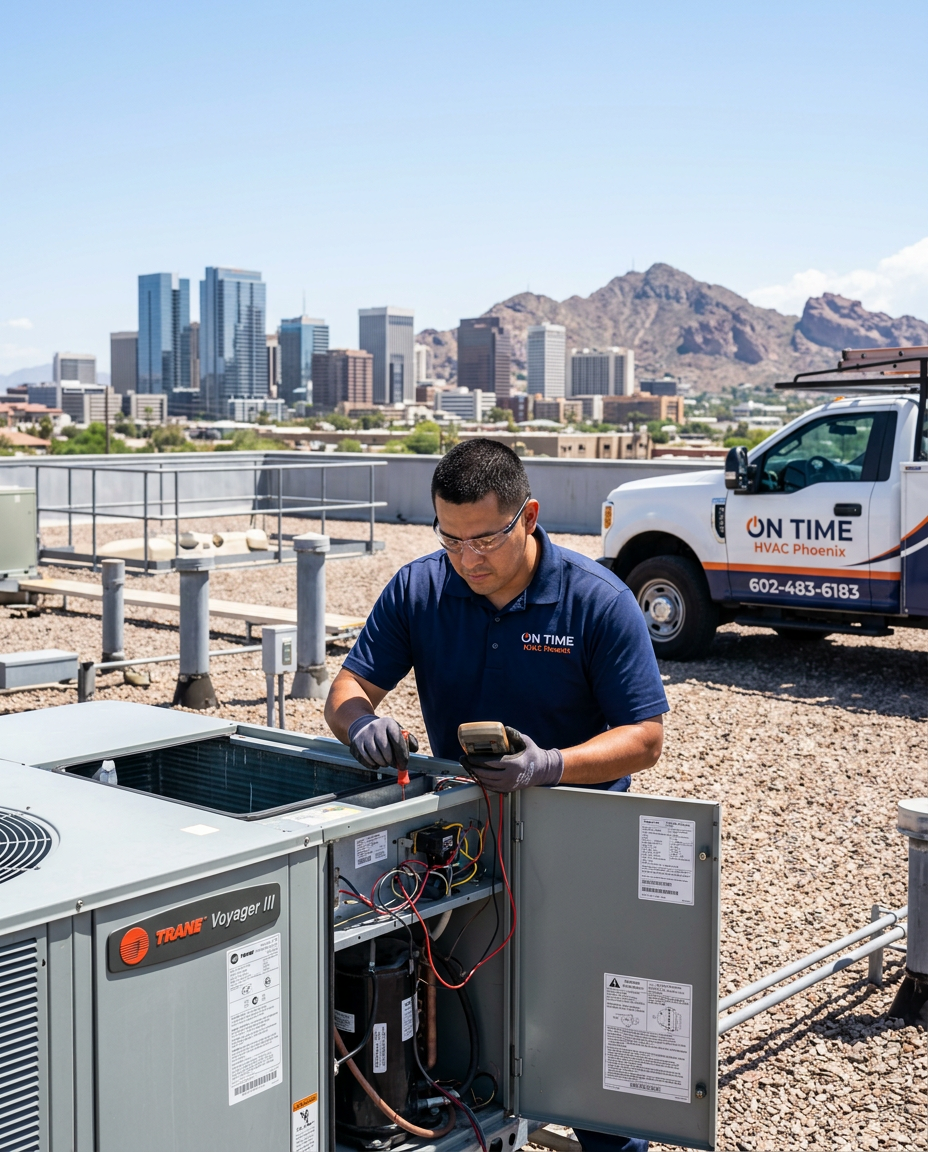 Phoenix commercial HVAC maintenance and equipment replacement guidance from On Time HVAC Phoenix
 Maintenance Schedules and Planning Requirements
Residential homeowners might schedule an annual tune-up before summer; commercial facility managers typically operate under Planned Maintenance Agreements (PMAs) that require quarterly or monthly inspections depending on system age and criticality. Commercial HVAC maintenance helps prevent unexpected downtime, equipment failure during peak seasons, refrigerant leaks that damage the environment, and energy waste that inflates utility bills. In the Phoenix area, where cooling season extends from April through November—nine months of intense demand—proactive maintenance matters. The desert's unique challenges compound maintenance needs: dust storms clog outdoor unit fins, hard water mineral deposits accumulate in pipes and heat exchangers, extreme UV radiation degrades outdoor components, and low humidity creates static electricity risks. Commercial buildings near Washington Park in the Alhambra area face additional considerations during monsoon season (July-September) when sudden flooding and humidity spikes stress cooling systems. A professional maintenance plan should include filter changes every 30-60 days, annual coil cleaning, condenser unit inspection, refrigerant level verification, capacitor microfarad testing, electrical connection tightness checks, and condensate drain line flushing.
Refrigerant, Regulations, and Compliance
Commercial HVAC systems operate under strict EPA Section 608 certification requirements for refrigerant handling, and only certified technicians can legally service these systems. The refrigerant landscape changed dramatically in January 2020 when R-22 was fully phased out due to ozone-depletion concerns; commercial systems now run on R-410A, R-32, or newer low-global-warming-potential refrigerants. Any technician without EPA certification attempting refrigerant service violates federal law and exposes property owners to fines. The SEER2 rating system replaced the older SEER standard in January 2023, and new commercial equipment must meet minimum efficiency requirements (14.3 SEER2 for split systems in the Southwest region). When evaluating whether to repair or replace aging commercial systems, business owners should understand that a 20-year-old boiler or chiller operates at 60-70% efficiency compared to modern equipment at 90%+ efficiency. Replacement often delivers return on investment through reduced energy costs within 5-7 years, plus eliminated repair expenses and improved system reliability.
Cost Structure and Budget Considerations
Commercial HVAC service costs follow entirely different models than residential work. A residential service call might cost $75-$150; our commercial diagnostic work often requires $200-$400 because we spend time measuring multiple temperature and pressure points, analyzing building automation system data, and generating detailed reports. Refrigerant recharges cost $300-$600 in residential settings but can reach $1,000+ in commercial systems due to larger quantities and hazardous refrigerant handling protocols. Capacitor replacement runs $150-$400 residential versus $300-$600 commercial; compressor replacement escalates from $1,500-$4,000 residential to $3,000-$8,000+ commercial depending on tonnage and warranty provisions. Full system replacement ranges from $4,000-$12,000 for a residential home versus $15,000-$100,000+ for commercial installations. Annual maintenance agreements typically cost $150-$300 per residential unit but $500-$2,000+ annually for commercial systems depending on tonnage, complexity, and inspection frequency. We offer transparent, fair pricing that reflects the true scope of commercial work without hidden fees—our 5-star Google reviews reflect customers' confidence in our honest approach and professional service.
Diagnostic Testing and Performance Verification
Professional commercial HVAC diagnostics involve measurements that homeowners typically never see. Superheat and subcooling measurements verify refrigerant charge accuracy within 2-5 degrees—critical for compressor longevity and system efficiency. Static pressure testing identifies ductwork leaks that waste 20-30% of conditioned air. Temperature differential testing (supply air versus return air should be 15-20°F for cooling) reveals airflow restrictions or evaporator coil problems. Amp draw measurements on compressor and fan motors detect electrical stress or bearing wear. Capacitor microfarad testing confirms whether capacitors are degrading and approaching failure. High-side and low-side refrigerant pressure readings establish whether the system matches design specifications. CFM (cubic feet per minute) airflow measurements per ton of cooling verify the system delivers adequate air circulation. We conduct thorough diagnostic testing on every commercial maintenance visit, explaining results clearly so facility managers understand system status and make informed decisions.
When Repair Stops Making Financial Sense
The decision to repair versus replace aging commercial equipment follows sound financial logic. Most commercial HVAC components have design lifespans: compressors typically last 15-20 years, condenser coils 15-25 years, blower motors 12-18 years, and control boards 10-15 years. When a system reaches 15+ years old and requires major component replacement, the cumulative repair costs often exceed 40-50% of replacement cost. A 20-year-old boiler or commercial chiller represents technology from the early 2000s with efficiency ratings 30-40% below current equipment. If that aging system requires a $4,000 compressor replacement or $3,000 in coil repair, spending an additional $8,000-$15,000 to replace the entire system positions the business with modern, efficient equipment under manufacturer warranty. Energy savings alone recover replacement investment within 5-10 years. We help commercial clients evaluate repair versus replacement through honest cost-benefit analysis, confirming decisions are based on long-term building performance and operational budgets.
Protecting Your Commercial Investment
Commercial HVAC maintenance represents preventive investment in operational continuity, employee comfort, customer satisfaction, and equipment longevity. Regular maintenance catches small problems before they become expensive failures. Cleaning condenser coils annually in Alhambra's dusty desert environment prevents efficiency loss and overheating. Replacing filters every 30-60 days maintains airflow and system efficiency. Monitoring refrigerant levels prevents compressor damage. Testing electrical connections prevents fires. These maintenance activities prevent emergency calls and catastrophic failures. Professional maintenance also creates documentation that satisfies insurance requirements, supports warranty claims, and demonstrates due diligence if performance disputes arise. We understand how stressful unexpected equipment failure can be—that's why proactive maintenance provides peace of mind. With years of experience serving Alhambra business owners, On Time HVAC Phoenix has built a reputation for reliable, professional service. Call us at 602-483-6183 or visit https://ontimehvacphoenix.com/ to schedule your commercial maintenance plan today.
Visit 26 E Pima St Phoenix for commercial HVAC maintenance services from On Time HVAC Phoenix "@context": "https://schema.org", "@type": "LocalBusiness", "name": "On Time HVAC Phoenix", "telephone": "602-483-6183", "address": "@type": "PostalAddress", "streetAddress": "26 E Pima St", "addressLocality": "Phoenix", "addressRegion": "AZ", "postalCode": "85003" , "url": "https://ontimehvacphoenix.com/", "areaServed": "Alhambra", "description": "Professional Commercial HVAC Maintenance serving Alhambra in Phoenix, AZ.", "sameAs": ["https://www.facebook.com/OnTimeHVACPho/","https://www.instagram.com/ontimehvacpho/","https://www.youtube.com/@OnTimeHVACPho","https://www.linkedin.com/company/ontimehvacpho/","https://x.com/OnTimeHVACPho","https://www.tiktok.com/@ontimehvacpho","https://www.pinterest.com/OnTimeHVACPho/"], "image": "@type": "ImageObject", "url": "https://lh3.googleusercontent.com/d/1dYft0XUKv2p207YHCBlAa8Mig6DEVktS", "name": "Commercial HVAC Maintenance in Alhambra: Business Owners' Guide to Equipment and Planning Service Image", "description": "Image for: Is it worth replacing a 20 year old boiler?", "encodingFormat": "image/png" , "audio": "@type": "AudioObject", "contentUrl": "https://drive.google.com/file/d/1c4IhiY4jN7XBbwqEdzkQbjOHuSIzyG0E/view", "name": "Commercial HVAC Maintenance in Alhambra: Business Owners' Guide to Equipment and Planning Expert Audio", "description": "Audio answer to: Is it worth replacing a 20 year old boiler?", "encodingFormat": "audio/wav"